


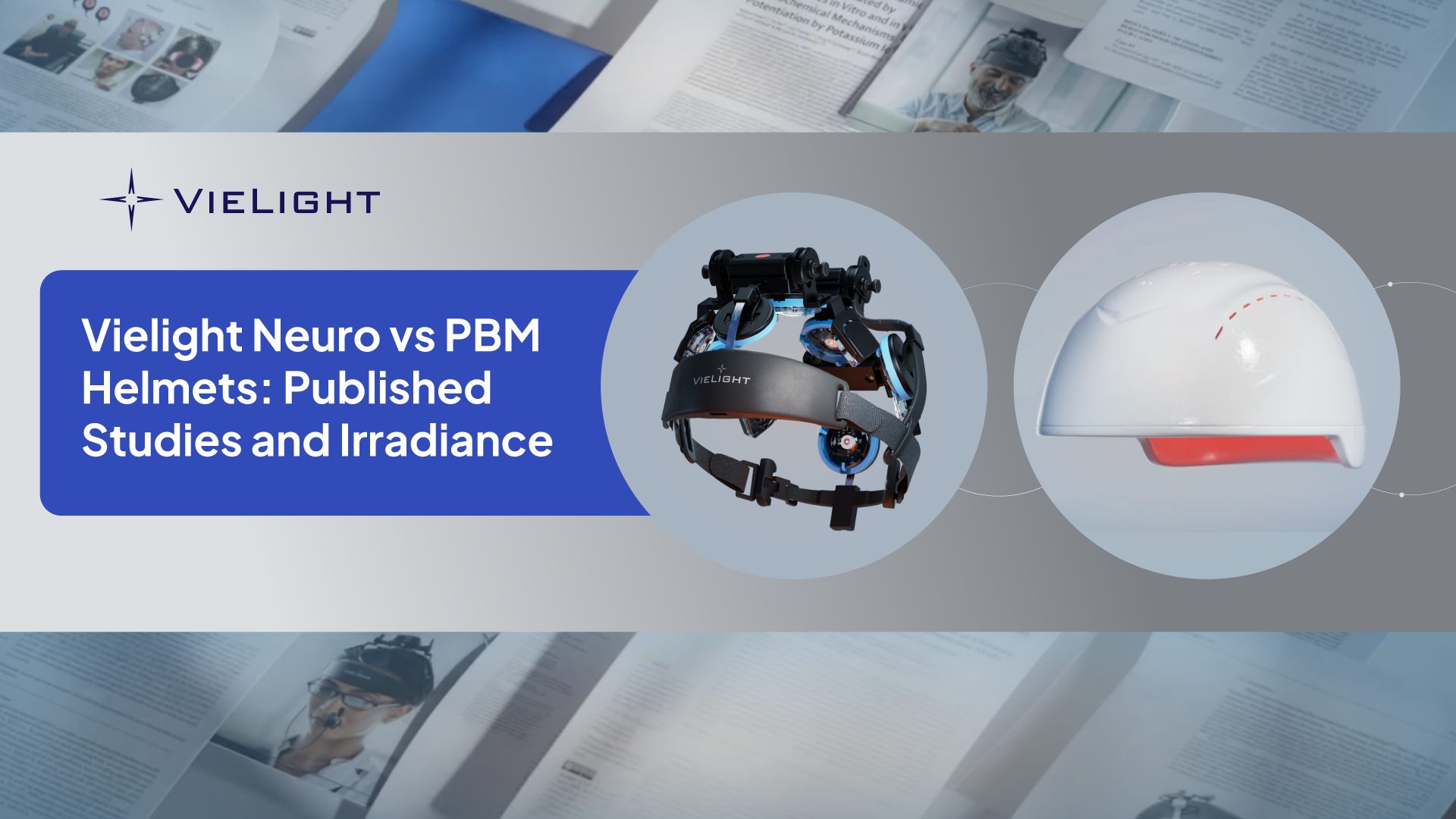
As the original inventors of home-use brain photobiomodulation technology in 2014, we learned that effective brain photobiomodulation is not simple.
Delivering the optimal amount of light energy into the brain in a safe and effective manner takes considerable research and engineering.
Here are the reasons behind the Neuro’s unique patented design.
Full transcranial coverage with an intranasal advantage
The Vielight Neuro is engineered for coverage by design, not by quantity. A small number of high-output Vie-LEDs, shaped to bypass hair, are engineered so that natural scattering in the scalp, skull and cerebrospinal fluid, (the brain consists of 70-80% water) broaden each beam into a large, overlapping halo. These halos interact to create an effectively full-transcranial footprint with extra focus over Default Mode Network (DMN) hubs.
The system’s intranasal pathway adds what the cranium alone can’t easily reach: via the cribriform plate, light has a short, porous route to ventral/frontobasal structures, completing dorsal-to-ventral continuity.
This physics-led approach avoids the need for hundreds of low-output LEDs that mainly paint the scalp—it uses fewer, stronger, well-placed emitters to deliver a meaningful energy footprint where it matters.
Watch a demonstration video of the Vielight Neuro vs a 1070 nm helmet.
The 810nm beam is invisible to the human eye but the vibrance is filmed by a CMOS camera.
Published clinical research comparisons
Vielight technology is featured in the most published research in the field of brain photobiomodulation by a significant margin and has the deepest penetration in the entire industry.
Be cautious of companies attributing research conducted with Vielight devices or other devices as attainable to their own.
Brain photobiomodulation is parameter-specific and our Vie-LED technology generates a unique laser-like profile and an industry-leading irradiance on specific and important brain networks, like the Default Mode Network.
Other devices cannot easily emulate our efficacy because of our proprietray Vie-LED technology, intranasal and design patents.
The table below is a benchmark studies published comparison against other random PBM helmets.
| Technology | Form Factor | Research | Manufacturer | Medical Grade |
|---|---|---|---|---|
| Vielight Neuro (Vielight) | Modular | 23 published (17 ongoing) |
Vielight, Canada | Yes |
| Weber Medical LED Infrared Helmet | Helmet | 0 published | Suyzeko, China (Private-labelled) |
– |
| Neuradiant 1070 (Neuronic) | Helmet | 3 published | Suyzeko, China (Private-labelled) |
– |
| Suyzeko PBM Helmet (Suyzeko) | Helmet | 1 published | Suyzeko, China | – |
*Data as of Sept 2025
Irradiance (Surface Power Density) Comparisons
Irradiance / Power Density Comparison
Vie-LED technology is unique and is engineered to generate a laser-like irradiance profile but with the safety of LEDs.
The PBM Foundation benchmarked the Vielight Neuro 3 against two PBM helmets, the Suyzeko NIR helmet and Neuronic Neuradiant twice, as case studies for their testing program to standardize irradiance reporting.
MegaLab and Optronic Lab, photonics engineering firms, conducted the tests:
When compared against the irradiance of peak natural sunlight (which is free) our Vielight Neuro generates 200-300% the irradiance of sunlight without the negative side effects of UV rays. The tested Neuronic and Suyzeko helmets generated less than 12% of sunlight’s peak irradiance.
A 2024 systematic review that screened 2,133 records and included 97 brain PBM studies reports that irradiance (power density) was typically ~250 mW/cm². The Vielight Neuro with an independently measured irradiance of 180-333 mW/cm², is mostly inline with the irradiance used in these studies, which included lasers. However, the Neuronic and Suzyeko helmets generated less than 5% of the average irradiance used over 97 analyzed brain PBM studies.
| Source | Independently measured irradiance | Manufacturer | % of Typical Brain-PBM Irradiance (≈250 mW/cm²) |
|---|---|---|---|
| Vielight Neuro (Vielight) | 180-350 mW/cm2 | Vielight, Canada | 80–160% |
| Neuradiant 1070 (Neuronic) | ≈9 mW/cm2 | Suyzeko, China (Private-labelled) |
≈4% |
| Suyzeko PBM Helmet (Suyzeko) | 5 mW/cm2 | Suyzeko, China | 3% |
| Natural Sunlight | 100 mW/cm2 | Free | 40% |

**Note: The irradiance of sunlight is approximately 100 mW/cm2 at sea level on a clear day.
Optimizing NIR Energy Delivery into the Brain
Delivering NIR light energy (810-1100nm) into the brain is difficult, especially with hair, scalp and body tissue.
There are several important physics-related factors regarding delivering NIR energy successfully into the brain.

Figure: Penetration of 810nm energy through a skull with the Vielight Neuro.
Image source: Uniformed Services University.
Sufficient irradiance.
Irradiance is defined as the concentration of light energy landed on a surface. (mW/cm2)
Sufficient irradiance is required for NIR light energy to penetrate the skin and skull, besides wavelength.
An optimal amount of irradiance is one of the most important metrics for effective brain photobiomodulation.

Figure: The body's optical window
Image source: Wang, Erica & Kaur, Ramanjot & Fierro, Manuel & Austin, Evan & Jones, Linda & Jagdeo, Jared. (2019). Safety and penetration of light into the brain. 10.1016/B978-0-12-815305-5.00005-1.
The proper wavelength range.
NIR light energy within the 800nm-1100nm wavelength range falls within the body’s optical window and a well-studied therapeutic effect on cells.
The body’s optical window refers to the range of wavelengths of light that can penetrate human tissues effectively
The 810nm wavelength has the lowest absorbance by tissue, blood, and water, according to a 2020 study by Harvard Medical School.
A wavelength between 800nm-1100nm is ideal for penetration because of the body’s optical window.
Video source: Infrared camera capture of Vielight Neuro Alpha footprint and intensity.
Minimizing distance of LEDs from the scalp.
Light energy gets weaker as it travels over distances due to the inverse square law of light.
As light spreads out from a light source, the irradiance (“or concentration of light energy”) decreases rapidly.
Zero distance between LEDs and the scalp is optimal.

The Problems with Helmets
Standard PBM helmets are not optimized for brain photobiomodulation. Here are several reasons why:
Hair as a barrier
The inflexible dome-shape of PBM helmets does not part hair, causing maximal loss through hair absorption.
Helmets are inflexible
Because they are inflexible, they can’t accommodate variations in head sizes and shapes well, introducing distance and rapid energy loss through the inverse square law of light.
Helmets often use many weak, inefficient LEDs
Utilizing many weak LEDs generates a high total power but a weak irradiance. A weak irradiance means that the concentration of landed light energy that lands on the scalp is insufficient to penetrate.
Helmets trap heat – ventilation is an issue
The lack of ventilation in closed helmets leads to heat build up, leading to discomfort or the placebo effect.
The Myth of Total Power
When it comes to brain photobiomodulation, total power output only matters if the NIR light energy has sufficient irradiance to penetrate the skull.
Total power can be increased by using many weak LEDs. Here’s an example: 1 mW x 10,000 LEDs = 10,000 mW total power output but just 1 mW/cm2 of irradiance, or just 1/30 of the irradiance of the NIR spectrum of sunlight.
Total power output is not as important as irradiance (power per unit area, mW/cm²). This position misrepresents a key principle of effective light delivery in PBM, especially when targeting deep brain structures. Let’s break down why irradiance is the critical parameter for meaningful transcranial photobiomodulation.
- Irradiance, Not Just Total Power, Drives Efficacy
The depth of penetration and the stimulation of mitochondrial chromophores like cytochrome c oxidase depend on a sufficient irradiance threshold at the tissue interface. If the irradiance is too low, especially at the scalp, the photons do not reach deeper cortical or subcortical targets effectively—even if total emitted power is high.
More LEDs with lower irradiance increase coverage but do not compensate for low penetration. This limitation—they may increase coverage, but they do not enhance penetration unless irradiance per diode is sufficiently high.
The Vielight Neuro | Modular Engineering
The Vielight Neuro’s patented transcranial-intranasal design is engineered for optimal NIR energy transmission, minimal heat generation and maximum comfort.
Here are the reasons why our brain photobiomodulation technology is featured in the most published studies globally.

| Factor | Engineering Response |
| Distance of NIR energy source from the scalp |
|
| Sufficient irradiance |
|
| Variations in head sizes and shapes |
|
| Ventilation |
|
| Targeting Different Brain Networks |
|
Medical Device Standards
Vielight is the only North American photobiomodulation device manufacturer that is classified as a medical device manufacturing company, certified under ISO 13485, MDSAP and MDR. Our technology is FDA and Health Canada registered.
Over the years, Vielight has released more than 100,000 devices into the market. There have been no reports of significant adverse events attributed to our products. This is also supported by the large, randomized control clinical trials using Vielight products.
We manage the power of our LEDs to put care and safety first while pursuing optimal efficacy. We make no medical claim unless supported by scientific evidence.
Validation via Research
At Vielight, we understand the need to validate the engineering theory behind our devices with scientific data. A simple idea like placing LEDs on your head can turn surprisingly complex when taking different parameters into account, like the pulse rate, wavelength and power density to maximize efficacy.
With that in mind, we’ve invested heavily in research and clinical trials over the years.
For a full list of published research that used our devices: Link
We are grateful to all the research institutions we’ve collaborated with over the years and look forward to a bright future of discoveries together.
Light-Based Terminology
- Power density (mW/cm2)
Power density is the amount of light energy emitted directly from the source.
Power density can be hindered by distance and hair and is not an accurate indication.
- Irradiance (mW/cm2)
Irradiance is the amount of light energy landed on a surface from the source.
While surface radiant power density and radiant power density share the same measurement unit mW/cm2, they are not equivalent.
Surface radiant power density gives an accurate picture of how much energy the scalp receives.
- Total power
Total power is defined as the total amount of energy emitted over a period of time by all light sources.
Many weak inefficient LEDs can generate a high total power but if the surface radiant power density is too low and if blocked by hair, light energy won’t penetrate the skull.


